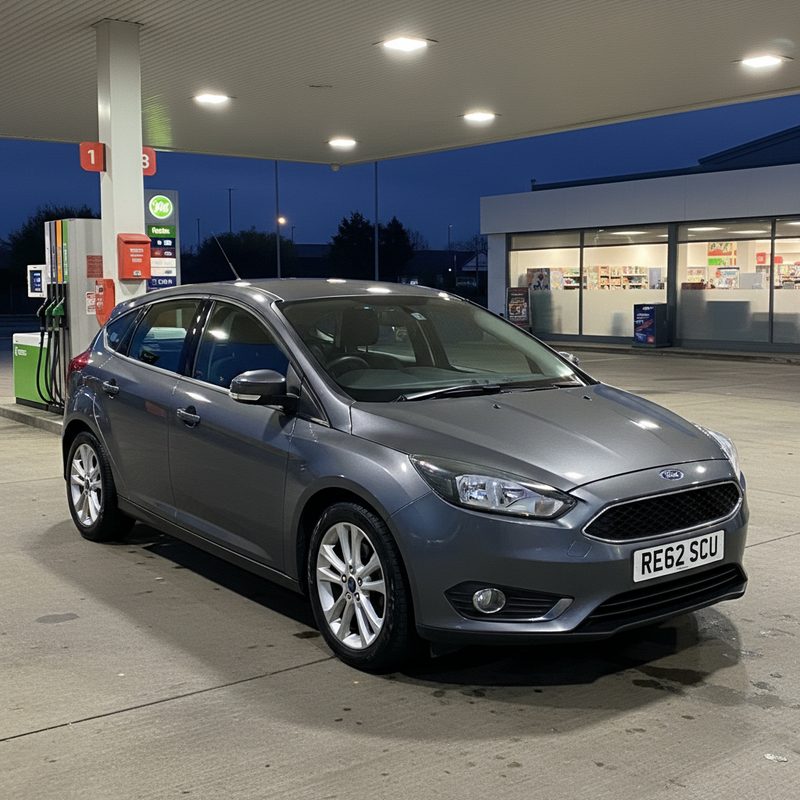
How Much to Offer on a Used Ford Focus — Exact Script
Planning to buy a used Ford Focus? The real market prices, a tested negotiation script, and the Focus-specific issues that put you in the driving seat when haggling.
The Real Price of a Used Ford Focus Right Now
The Ford Focus is one of those cars that everyone thinks they know the value of -- but most people get it wrong. Sellers overprice them because they reckon the Focus name carries weight, and buyers underprepare because they assume a Focus is "just a Focus." Both sides are making mistakes, and today I'm going to make sure you're not on the losing end.
Let me lay out what you should actually be paying:
- 2018-2024 Focus (Mk4): £9,500 to £19,000. The newer Focus holds its value better than the Fiesta. An ST-Line with the 1.0 EcoBoost and 35,000 miles sits around £12,000-£14,500. Titanium X and Vignale push higher. The 1.5 EcoBlue diesel is popular with motorway drivers and commands a slight premium.
- 2014-2018 Focus (Mk3.5 facelift): £5,000 to £9,500. The sweet spot for used Focus buying. A Zetec or Titanium with 50,000-70,000 miles should be £6,000-£8,000.
- 2011-2014 Focus (Mk3): £3,000 to £6,000. Good cars at this age but watch for the PowerShift automatic gearbox -- it's a known money pit.
- 2005-2011 Focus (Mk2/2.5): £1,500 to £3,500. Still solid if looked after. Rust checks are essential at this age.
Anything above these ranges needs serious justification. Anything within them is negotiable.
Focus-Specific Leverage Points You Need to Know
The Focus has some well-documented issues that most sellers pray you won't research. Here they are:
The PowerShift gearbox disaster. If you're looking at a 2011-2018 Focus with the automatic gearbox (the dual-clutch PowerShift unit), this is your nuclear option in negotiations. These gearboxes have a terrible reputation for shuddering, slipping, and failing entirely. A replacement runs £2,000-£3,000. Even if the current one feels fine, the risk is real and documented. Use this knowledge to negotiate hard, or better still, stick to the manual.
1.0 EcoBoost coolant issues. Just like the Fiesta, the 1.0 EcoBoost in the Focus suffers from coolant hose failures and, in some cases, cracked cylinder heads from overheating. Ford issued recalls on earlier models. Ask whether the recall work has been done. If it hasn't, that's a significant negotiating point.
Rear suspension knocking. The Mk3 and Mk3.5 Focus are notorious for rear suspension knocking. The rear lower arms and bushes wear out, creating an annoying clunk over bumps. Replacement costs £250-£400 at a garage. Check the MOT history for rear suspension advisories.
Diesel DPF problems. The 1.5 and 1.6 TDCi engines suffer DPF blockages if the car has been used mainly for short trips. A DPF replacement is £800-£1,200. If the car is diesel and the MOT history shows low annual mileage (under 6,000), the DPF is likely compromised.
Interior trim quality. The Focus interior, especially on Mk3 models, wears badly. Peeling door cards, sticky dash panels, and worn driver's seats are common. While not safety issues, they reduce the car's value and give you grounds for a lower offer.
Your Negotiation Script -- Adapted for the Focus
Here's the conversation you want to have. Adjust the specifics to match the car you're viewing.
Arrival and inspection (first 10 minutes):
Don't start talking money immediately. Walk around the car, check the tyres, look underneath if you can, open the bonnet, check the oil. Let the seller watch you being thorough. This signals that you know what you're doing and puts them in a more honest frame of mind.
Opening the negotiation:
YOU: "Cheers for letting me have a look. It's a decent car -- I can see it's been used properly. I've been looking at a few Focuses this week, and I want to be straight with you: I've done my homework on prices and history. What's the absolute best you could do on this?"
SELLER: Usually gives a small discount or says the price is firm.
YOU: "OK, I appreciate that. Here's where I'm at though. I've checked the MOT history and there are advisories for [name the specific items -- brake wear, suspension, whatever you found]. The tyres on the [front/rear] are getting low too. I've also seen similar Focuses with full history going for about £[quote a real lower price you found]. Taking all that into account, I think £[your target -- 12-15% below asking] is a fair number for both of us."
SELLER: Counters with a higher number.
YOU: "Tell you what -- meet me at £[your target + £100-200] and I'll sort the payment today. No messing, no coming back for a second look. Done and dusted."
This back-and-forth should land you somewhere around 8-12% below the original asking price, which on a £10,000 Focus is £800-£1,200 saved.
When You Should Absolutely Walk Away
Not every Focus is worth negotiating on. Some are worth avoiding entirely:
- Any automatic Focus from 2011-2018 where the seller dismisses PowerShift concerns. If you ask about the gearbox and they say "it's fine, never had a problem," but they can't show you service records proving the clutch packs have been replaced or the software updated, walk away. The repair bill if it goes wrong dwarfs any discount.
- High-mileage diesels with no DPF regeneration history. If a 1.6 TDCi Focus has done 120,000 miles and the seller can't tell you about DPF maintenance, that's a gamble you don't need to take.
- Focus RS or ST models with modified exhausts, lowered suspension, or aftermarket engine management. Modified performance Focuses have almost certainly been driven hard. The resale market for modified cars is smaller, meaning the seller should be pricing accordingly. If they're asking standard RS/ST money for a modified one, they're dreaming.
- Any Focus where the MOT mileage doesn't make sense. The Focus is a common target for mileage clocking because there are so many of them and they depreciate heavily with mileage. If the MOT shows 60,000 miles last year and the car now claims 62,000, but it was doing 12,000 a year before that, something stinks.
Dealer Games to Watch For
Focus buyers at dealerships face the same tricks as anyone else, but there are a couple of Focus-specific ones:
Steering you toward the PowerShift auto "because it's more desirable." Dealers know the PowerShift models are harder to shift (pardon the pun). They'll try to frame it as a positive: "Automatic is always easier to sell." It's not. It's harder because informed buyers avoid it. If they're pushing an auto Focus, the price should reflect the gearbox risk.
Hiding the trim level. The Focus has a bewildering number of trim levels -- Style, Zetec, Zetec S, Titanium, Titanium X, ST-Line, Active, Vignale, ST, RS. Some dealers will list a lower-spec car as if it's a higher trim. Check the actual spec against Ford's original trim listings for that year. A Zetec listed as a Titanium is not a bargain -- it's a con.
"This one has the navigation upgrade." On Mk3 and Mk3.5 Focuses, the standard SYNC system is terrible. Some had the SYNC 2 or SYNC 3 upgrade, which is genuinely better. But it's not worth £500 extra. Most people use their phone for navigation anyway.
Using MOT History to Build Your Case
The Focus MOT check is absolutely critical, and here is why. Pull up the DVSA MOT history before you even book a viewing. Here's what Focus-specific items to flag:
If you are considering a Ford, you should also read our Should I Buy a 2019 Ford Galaxy? Dave's Honest Verdict guide for the full picture.
Suspension advisories. On the Mk3/3.5, rear suspension issues are practically guaranteed after 50,000 miles. If the MOT mentions "rear suspension arm ball joint worn," that's money you'll be spending soon. Quote the cost (£250-£400) directly to the seller.
Brake condition. Focuses eat front brakes, especially the heavier diesel models. Front discs and pads every 25,000-35,000 miles is normal. If the last MOT advised on brakes and the car has done significant mileage since, you're looking at a £200-£300 bill.
Emission readings. On EcoBoost engines, declining emission figures across successive MOTs can indicate a catalytic converter issue. On diesels, rising emissions suggest DPF problems. Either way, it's evidence you can use.
Corrosion on structural elements. The Mk2 and Mk2.5 Focus is prone to underside corrosion, particularly around the rear beam and subframe mounts. If an MOT mentions corrosion anywhere structural, factor in a repair or walk away.
Dave's Bottom Line
The Ford Focus is arguably the best all-round used car in Britain. Comfortable, practical, decent to drive, and cheap to maintain when everything works. But that popularity means sellers think they can charge a premium, and too many buyers let them. Arm yourself with the information in this guide, check the MOT history thoroughly, and don't be afraid to name a fair price and stick to it.
Before you view any Focus, run the registration through Dave's vehicle check. I'll give you the full MOT breakdown, highlight the generation-specific problems to watch for, and arm you with a set of negotiation points that are tailored to that exact car. It's the closest thing to having me standing next to you at the viewing.
Check Ford Focus, instantly with Dave's free vehicle intelligence report.
Get Dave's negotiation points for this car