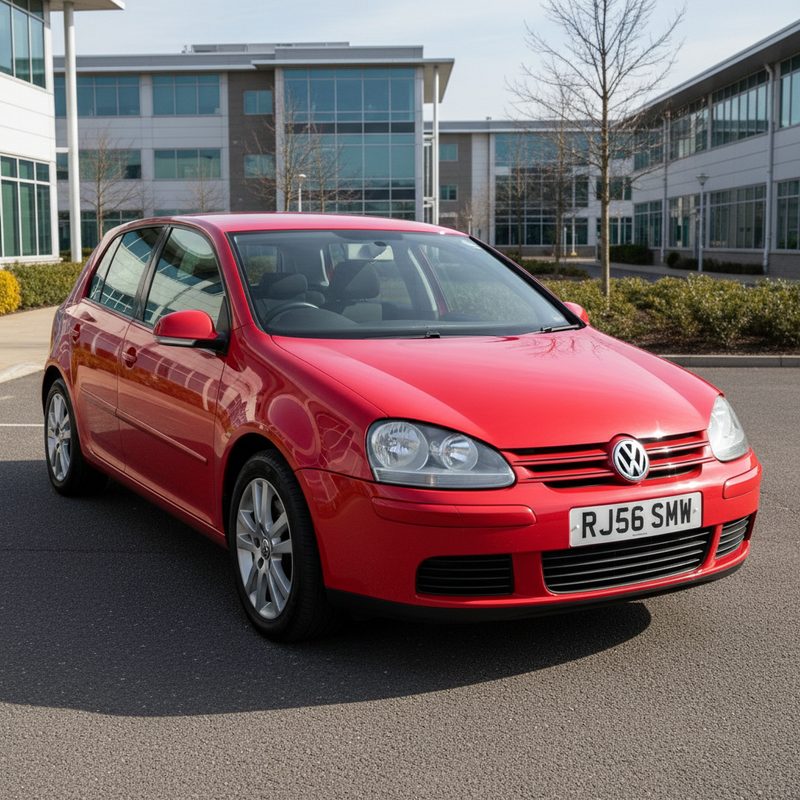
When Does a VW Golf Stop Losing Value
The VW Golf stops losing serious money at 5 to 6 years old, but the smart buy is at 3 to 4 years. Full curve, rival comparison, and value strategy.
The Golf Depreciation Curve
The VW Golf holds its value better than almost every mainstream hatchback, a consequence of strong brand perception, high used demand, and the Golf's reputation as the default "sensible choice." But it still loses a significant chunk of its value in the first three years, and understanding the curve precisely helps you buy at the point where someone else has absorbed the worst losses while the car still has years of reliable life ahead.
Here's how a Golf 1.5 TSI Match bought new at £27,000 typically depreciates:
| Age | Mileage | Typical Value | % Retained | Annual Loss |
|---|---|---|---|---|
| New | 0 | £27,000 | 100% | , |
| 1 year | 10,000 | £20,500 | 76% | £6,500 |
| 2 years | 20,000 | £17,500 | 65% | £4,750 avg |
| 3 years | 30,000 | £15,000 | 56% | £4,000 avg |
| 4 years | 40,000 | £12,500 | 46% | £3,625 avg |
| 5 years | 50,000 | £10,500 | 39% | £3,300 avg |
| 6 years | 60,000 | £9,000 | 33% | £3,000 avg |
| 7 years | 70,000 | £8,000 | 30% | £2,714 avg |
| 10 years | 100,000 | £5,500 | 20% | £2,150 avg |
The steepest drop is year one. You lose approximately £6,500 (24% of the car's value) simply by being the first registered keeper. Between years 4 and 7, the annual loss slows to approximately £1,000 to £1,500/year. After year 7, depreciation practically flatlines at £500 to £800/year: at this point, the car is losing less value annually than a set of replacement tyres.
The cumulative loss in years 1 to 3 is £12,000: that's the same amount the car loses in total over years 4 through 10. This single insight determines when to buy: let the first owner absorb the cliff, then buy the car for 44 to 56% of its original price.
The Sweet Spot: 3: 4 Years Old
For the best balance of value, reliability, and remaining useful life, buy a Golf at 3 to 4 years old with 25,000 to 40,000 miles. Here's the full case:
Financial advantage: Someone else has absorbed 44 to 54% of the new price. You're paying £12,500 to £15,000 instead of £27,000 for an essentially modern car. The depreciation you'll suffer from here is £1,000 to £1,500/year, roughly £100/month. That's less than most people spend on fuel.
Mechanical advantage: VW's 3-year warranty means any factory defects should already have been identified and resolved under warranty. The engine, gearbox, and major components are thoroughly run-in but nowhere near end-of-life. Nothing expensive is due until 60,000+ miles (timing chain, clutch, major suspension components).
Technology advantage: A 3 to 4 year old Mk8 Golf (2020+) has current-generation infotainment (however controversial), full ADAS driver assists, LED lighting, and the latest safety tech. It won't feel outdated for another 5+ years. Even a 3-year-old Mk7.5 (2017 to 2020) has a high-quality cabin and intuitive infotainment that still competes with new cars from mainstream rivals.
PCP return flood: The majority of new Golfs are sold on 3-year PCP deals. At the 3-year mark, a wave of well-maintained, low-mileage ex-PCP Golfs enters the used market simultaneously. This oversupply pushes prices down, particularly at franchise dealer Approved Used programmes where stock management pressure drives competitive pricing.
How the Golf Compares to Rivals
| Car (3 years, 30k miles) | New Price | Used Price | Retained % | Annual Depreciation |
|---|---|---|---|---|
| VW Golf 1.5 TSI Match | £27,000 | £15,000 | 56% | £4,000 |
| Ford Focus 1.0 EcoBoost ST-Line | £27,000 | £14,000 | 52% | £4,333 |
| Toyota Corolla 1.8 Hybrid | £29,000 | £17,000 | 59% | £4,000 |
| Vauxhall Astra 1.2 Turbo SRi | £24,000 | £11,000 | 46% | £4,333 |
| Hyundai i30 1.0T Premium | £23,000 | £11,500 | 50% | £3,833 |
| SEAT Leon 1.5 TSI FR | £25,000 | £13,000 | 52% | £4,000 |
| Skoda Octavia 1.0 TSI SE | £27,000 | £14,500 | 54% | £4,167 |
The Golf retains a higher percentage than every rival except the Toyota Corolla. However, higher retention means a higher used purchase price: you pay more to buy, but you also lose less when you sell. Over a 3-year ownership cycle, the total depreciation cost is remarkably similar across the segment, roughly £4,000 to £5,000 from year 3 to year 6.
The key difference is the starting capital required. A 3-year-old Golf costs £15,000, while a 3-year-old Astra costs £11,000. Both lose approximately the same amount over the next 3 years. If capital is tight, the Astra makes financial sense; if capital isn't the constraint, the Golf offers a better ownership experience with stronger resale at exit.
Check how the Golf compares to the Audi A3 if you're considering the premium alternative, and the Polo depreciation curve if the smaller VW is on your radar.
What Affects Golf Resale Value
Trim level matters significantly: R-Line and GTI/GTD trims hold value markedly better than base Life trim. An R-Line Golf commands a 10 to 15% premium over an equivalent-year Life model at any mileage point. The reason is straightforward: R-Line has the styling and equipment that the majority of used Golf buyers want, so demand is disproportionately strong.
| Trim | 3-Year Residual | Used Demand |
|---|---|---|
| Life | 50 to 54% | Moderate, basic specification limits appeal |
| Style | 52 to 56% | Good, better equipment hits the mainstream |
| R-Line | 56 to 60% | Strong, sporty styling drives demand |
| GTI | 62 to 68% | Very strong, enthusiast demand creates a floor |
| R | 65 to 72% | Excellent, limited supply, strong demand |
Colour matters: White, grey, and black account for over 65% of used Golf searches on AutoTrader. These colours sell fastest (average 2 to 3 weeks to sell) and for the highest prices. Blue is acceptable. Unusual colours (yellow, orange, green) sit 2 to 4 weeks longer and can trade at 5 to 8% less than equivalent mainstream-colour cars.
Service history is critical: Full VW dealer history adds 8 to 12% to the achieved price compared to independent-service-only cars. The gap is particularly pronounced at the 3 to 5 year mark where buyers are spending £12,000 to £15,000 and expect documentation. Keep every stamp. It pays for itself at resale.
Mileage thresholds: Values dip noticeably at round-number milestones, 30,000, 50,000, 75,000, and 100,000 miles. Buying just above these thresholds gives you a discount of £300 to £600 without any meaningful increase in mechanical wear. Conversely, selling just below them (e.g., at 49,000 rather than 52,000 miles) adds £300 to £500 to the achieved price.
When to Sell a Golf
If you already own a Golf, the optimal sell points depend on your circumstances:
- At 2 years / 20,000 miles: if you're on PCP and the balloon payment is lower than market value. You're in profit, buy the car and sell privately for the gap
- At 4 to 5 years / 40,000 to 50,000 miles: before major service items (timing chain inspection, potential clutch wear, DSG major service) become due. You sell a car that's "ready to go" with nothing expensive looming
- At 8+ years / 80,000+ miles: at this point the car is worth £5,000 to £7,000, annual depreciation is negligible (£500 to £800), and the smart move is to keep driving until something expensive breaks. The annual depreciation cost is lower than a monthly lease payment
Between 5 and 8 years, you're in a middle ground, still losing £500 to £1,000/year in depreciation while approaching the age where repair bills can spike (suspension refresh, potential clutch, ageing turbo). For the full cost picture, check the VW Golf running costs guide.
Dave's Depreciation Verdict
The VW Golf stops losing serious money at around 5 to 6 years old: beyond that point, annual depreciation drops below £1,000 and becomes one of the smallest ownership costs. The buying sweet spot is 3 to 4 years old for someone who wants a modern, well-equipped car at a significant discount. If you're pure value-hunting, a 6 to 7 year old Golf at £8,000 to £9,000 with a clean MOT history and full VW service stamps is one of the smartest used car purchases available in the UK.
Just factor in that repair costs rise with age, budget an extra £500 to £800/year for maintenance once past 60,000 miles. The Golf's parts are competitive (shared across the VW Group platform with Leon, Octavia, and A3), independent garages know them inside out, and the car's fundamental build quality means properly maintained examples routinely exceed 200,000 miles. Buy at the right time, maintain it properly, and the Golf costs less per mile than almost any rival.