How to Transfer Car Ownership When Buying Private — Dave's Complete Guide
Buying privately? Exactly how to transfer ownership properly, from the V5C paperwork to DVLA notifications, tax, and insurance.
Private Sales Need Proper Paperwork
When you buy a car from a dealer, the dealership handles most of the ownership transfer for you. When you buy privately, it is entirely down to you and the seller to get it right. And if you get it wrong, you can end up with a car you cannot tax, fines addressed to the previous owner landing on your doormat, or weeks of chasing the DVLA to sort out a paperwork mess.
I have helped dozens of buyers navigate this process, and the good news is that it is actually straightforward once you know the steps. Here is the complete guide.
Understanding What Ownership Transfer Actually Means
First, a quick clarification that trips up a lot of people. When we talk about transferring car ownership in the UK, we are really talking about changing the registered keeper on the V5C registration certificate. The V5C records who is responsible for the vehicle. It is not technically a proof of ownership, although in practice, the registered keeper is almost always the owner.
The V5C matters because it determines who is liable for vehicle tax, who receives correspondence from the DVLA, and who is contacted if the car is involved in an offence.
Before the Sale: Preparation
For the Buyer
Before you agree to buy the car, make sure you have done the following:
- Run a vehicle history check to confirm there is no outstanding finance, stolen marker, or write-off history
- Checked the MOT history online
- Inspected and test-driven the car
- Verified that the V5C is genuine (correct watermark, not a photocopy) and in the seller's name
- Confirmed that the VIN on the V5C matches the VIN on the car in at least two locations (windscreen base and door pillar)
- Arranged insurance to start from the moment you take possession
For the Seller
The seller should have:
- The original V5C registration certificate in their name and at their current address
- Updated their address on the V5C if they have moved since it was issued
- Gathered both sets of keys and any other items included in the sale
Step-by-Step Transfer Process
Step 1: Complete Section 6 of the V5C
The seller fills in section 6 of the V5C, titled "new keeper or new name/address of existing keeper." This requires:
- The new keeper's full name (yours)
- Your full address including postcode
- The date of sale or transfer
- The seller's signature
It is important that this information is accurate. Any errors can cause delays in processing.
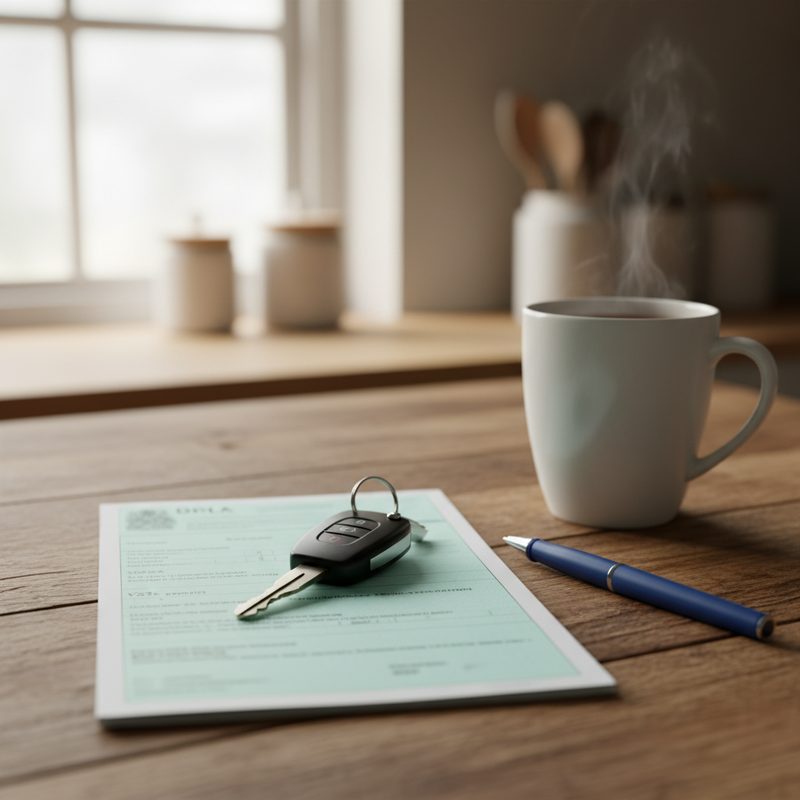
Step 2: Separate the V5C/2 Green Supplement
The V5C/2 is the green section of the V5C document. The seller tears this off and gives it to you, the buyer. This is your temporary proof that the car has been transferred to you, and you will need the reference number from it to tax the vehicle.
Keep the V5C/2 safe until your new V5C arrives from the DVLA.
Step 3: The Seller Notifies the DVLA
The seller has two options for notifying the DVLA:
Online (recommended). The seller goes to the DVLA's online service and notifies them of the sale using the document reference number from the V5C. This is instant and is the most reliable method.
By post. The seller sends the completed V5C (minus the V5C/2 section, which was given to you) to the DVLA at the address printed on the form. This takes longer and relies on the post.
The seller should do this on the day of sale. If they delay, they remain the registered keeper and are responsible for any fines, charges, or correspondence related to the vehicle.
Step 4: Tax the Vehicle
This is absolutely critical and must be done before you drive the car on public roads. Vehicle tax does not transfer with the vehicle. When the DVLA is notified of the sale, the previous owner's tax is automatically cancelled and they receive a refund for any full remaining months.
You tax the car using the 11-digit reference number from the V5C/2. This can be done online at the DVLA website or at a Post Office. You can pay for 6 or 12 months, or set up a monthly direct debit.
If you drive the car without taxing it, you risk a fine of up to £1,000 and the car could be clamped or seized.
Step 5: Insure the Vehicle
You must have at least third-party insurance before driving the car. Ideally, you should arrange this before collecting the car so that cover is in place from the moment the keys are handed over.
Most insurers allow you to take out a policy immediately, either online or over the phone. You can also add the car to an existing multi-car policy if you have one.
Step 6: Write a Receipt
A written receipt protects both parties. It should include:
- The date of sale
- The full names and addresses of both the buyer and seller
- The car's registration number, make, model, and colour
- The agreed sale price
- A statement that the car is sold free from any outstanding finance or encumbrances
- Both parties' signatures
You do not need a formal template. A handwritten receipt is perfectly valid as long as it includes the key information. Both parties should keep a copy.
Before buying, you can check the exact road tax cost on GOV.UK using the registration number.
Step 7: Receive Your New V5C
The DVLA will process the transfer and send you a new V5C in your name. This typically takes two to four weeks. When it arrives, check that all the details are correct: your name, address, and the vehicle details.
If you have not received the new V5C within six weeks, contact the DVLA. You may need to apply for a replacement using form V62.
What If the Seller Has Lost the V5C?
This happens more often than you might think. If the seller does not have the V5C, the transfer is more complicated but not impossible.
The seller can apply for a replacement V5C using form V62 from the DVLA. This costs £25 and takes about two to four weeks. Ideally, they should do this before the sale.
Alternatively, you can buy the car without the V5C and apply for one yourself using form V62, along with proof of purchase (the receipt) and proof of identity. However, this approach is riskier because you cannot verify the seller's details against the V5C.
Buying a car without a V5C is a significant red flag. The car could be stolen, subject to outstanding finance, or not the seller's to sell. If you proceed, a comprehensive vehicle history check is absolutely essential.
Common Problems and How to Avoid Them
The seller does not notify the DVLA. If the seller fails to notify the DVLA of the sale, they remain the registered keeper. This means fines, speeding tickets, and congestion charges related to the car will go to them. While this is primarily their problem, it can cause complications for you if you need to prove ownership. Follow up with the seller to confirm they have notified the DVLA.
The V5C address does not match the seller's address. If the seller has moved and not updated the V5C, the document is technically out of date. This is not necessarily a problem, but it reduces your ability to verify that the car belongs to the person selling it.
The VIN does not match. If the VIN on the V5C does not match the VIN on the car, do not buy the car. This could indicate a cloned vehicle or identity fraud.
Tax was not arranged before driving. Some buyers forget to tax the car and drive it home untaxed. This is illegal and can result in fines and penalties. Always tax before driving.
Dave's Private Transfer Checklist
- Run a vehicle history check before agreeing to buy
- Verify the V5C is genuine and in the seller's name
- Check the VIN on the V5C matches the car
- Have insurance in place before collecting
- Seller completes section 6 of the V5C
- Collect the V5C/2 green supplement
- Seller notifies the DVLA on the day of sale
- Tax the vehicle immediately using the V5C/2 reference
- Write and sign a receipt with all key details
- Wait for your new V5C and check the details
The paperwork might feel tedious, but getting it right protects you legally and financially. And before any of this paperwork matters, make sure the car is worth buying. Use Dave's vehicle check to confirm the history is clean before you commit your money. Use Dave to check any car you are considering.
Use Dave to check any car you're considering
Get Dave's free AI-powered vehicle check before you make a decision.