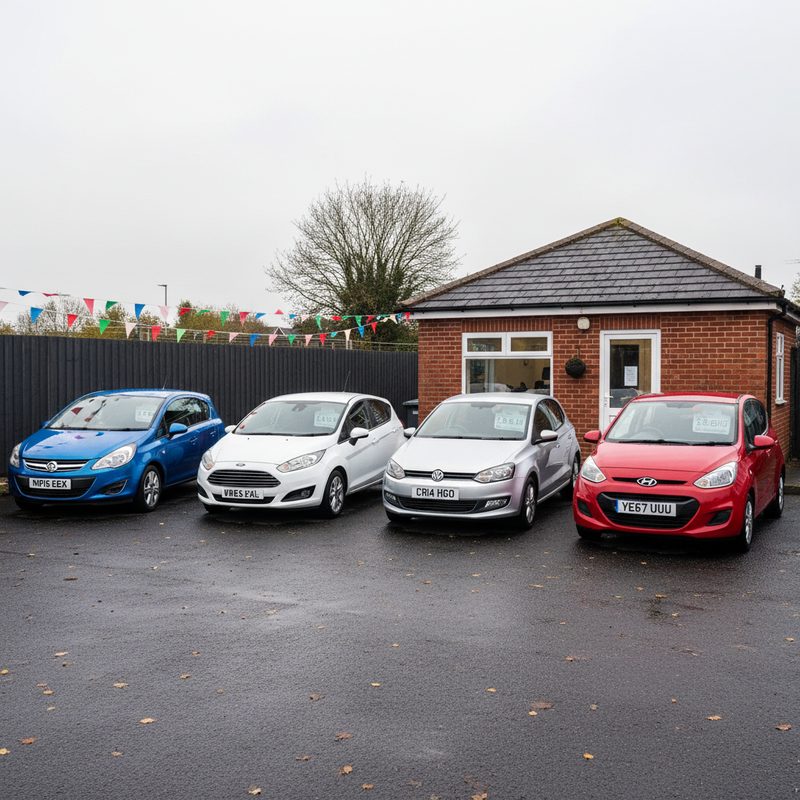
Best First Cars Under £2000: Dave Recommends
Two grand gets you into some genuinely decent first cars if you know where to look. Through five solid picks, their quirks, their running costs, and what to watch out for.
Two thousand pounds. Not a fortune, not a pittance -- it is that sweet spot where you have just enough to be choosy without being reckless. When someone asks me what they can get for two grand as a First Car, I always say the same thing: quite a lot, actually, as long as you are realistic about what quite a lot looks like.
You are not getting a shiny 2020-plate hatchback. What you are getting is a solid, sensible car that has been around the block a bit but still has plenty of life in it. The trick at this budget is finding cars that were well built in the first place and have been looked after since. Cheap to buy does not have to mean expensive to own, and that is exactly the principle behind every car on this list.
So pull up a chair, let me tell you about five motors that I would happily recommend to my own kids at this budget.
Peugeot 107 (2005-2014) -- The Penny Pincher's Dream
If your main goal is to spend as little as humanly possible on running a car, the Peugeot 107 is where it is at. This thing sips fuel like a kitten with a saucer of milk -- 55 to 65 miles per gallon is normal, and some owners report cracking 70mpg on a gentle motorway cruise.
The 107 shares its Toyota-engineered 1.0 litre engine with the Citroen C1 and Toyota Aygo. It is a proven unit that very rarely gives trouble. At £2,000 you will find 2010-2013 models with 40,000 to 70,000 miles, which is comfortably mid-life for an engine that regularly does 150,000 without drama.
Insurance sits in groups 1 to 3, which is about as low as it gets. road tax is either nothing or next to nothing. Servicing is cheap because there is so little to go wrong. You could realistically run a 107 for under £100 a month including fuel, insurance (with telematics), and maintenance. For a New Driver, that is outstanding.
The catch? It is tiny, slow, and about as refined as a garden shed on wheels. The motorway is not its happy place -- at 70mph the engine is working hard and the wind noise is loud enough to drown out your music. But around town, where most new drivers spend their time, it is absolutely brilliant. Light controls, great visibility, and you can park it in a gap that would make a Golf driver weep with envy.
One thing to check: the clutch. The 107's clutch takes a lot of punishment in stop-start traffic, and at this age they are often on their way out. If the bite point is near the top of the pedal, budget £400-£500 for a replacement fairly soon.
Volkswagen Fox (2006-2012) -- The Forgotten VW
Bet you did not see this one coming. The VW Fox was Volkswagen's budget model, built in Brazil and sold in Europe for about six years before being quietly discontinued. It was never popular, which means depreciation was savage, and that works wonderfully in your favour at this price point.
At £2,000, you can find 2008-2011 models with 50,000-70,000 miles. The 1.2 litre engine produces a modest 55bhp, which sounds terrible but the car weighs about 980kg so it never feels as slow as the numbers suggest. insurance groups sit at 1-4, fuel economy is around 48-52mpg, and the running costs are low.
The Fox feels like a proper Volkswagen. The doors have a satisfying clunk when they close, the interior is simple but well assembled, and the driving experience is more grown-up than you would expect from a budget car. It is not exciting, but it is solid and reassuring, which counts for a lot when you have just passed your test.
Why did nobody buy them? Honestly, because they were not much cheaper than a Polo when new, and the Polo was a better car. But at this budget, the Fox represents brilliant value -- you are getting VW build quality at Dacia money.
Parts availability is the one concern. Because so few were sold, some body panels and trim pieces can be tricky to find. Mechanical parts are mostly shared with other VW models though, so servicing is straightforward.
Suzuki Alto (2009-2014) -- The Featherweight Champion
The Alto weighs about 840kg, which makes it one of the lightest cars on sale in the modern era. That low weight means the tiny 1.0 litre engine does not have to work very hard, which translates to excellent fuel economy (55-60mpg), low insurance (groups 1-3), and minimal wear on brakes, tyres, and suspension components.
At £2,000, expect 2010-2013 models with 30,000-60,000 miles. These were often owned by older drivers who barely used them, so you can find some absolute gems with low mileage and full service history.
Suzuki builds tough little cars. The Alto has virtually no common faults worth worrying about. The engine is simple and reliable, the gearbox is light and precise, and there is very little to go wrong. It is the kind of car that you buy, service once a year, and forget about.
The downsides are obvious once you sit in one. The interior is cheap, the seats are basic, and the boot is so small you might struggle with a weekly shop. There is no real sound insulation, so motorway driving is tiring. And in a strong crosswind, the Alto's light weight means it gets pushed around more than heavier cars.
But for a town runabout that you need to get you to work, college, or the gym? Absolutely spot on. Running costs are almost hilariously low.
Fiat Punto (Mk3/Grande Punto, 2006-2018) -- More Car For The Money
If you want something that actually feels like a proper car rather than a city car, the Fiat Punto is worth a look. The Grande Punto (2006-2012) and its Punto Evo update (2009-2012) offer a decent amount of space, a comfortable ride, and -- in 1.2 or 1.4 petrol form -- reasonable running costs.
At £2,000, you are looking at 2009-2012 models with 50,000-80,000 miles. Insurance sits in groups 3-8 for the 1.2, which is manageable. Fuel economy is around 42-48mpg. The Punto is bigger and heavier than the city cars on this list, so it uses a bit more fuel and costs a touch more to insure, but the trade-off is a car that you can actually take on the motorway without feeling like you are taking your life in your hands.
Now, I need to be honest about Fiat reliability. The Punto is not terrible, but it is not Toyota levels of dependability either. Electrical gremlins are the most common issue -- random warning lights, central locking playing up, dashboard lights flickering. These are annoying but rarely dangerous or expensive. The mechanical side is generally solid if the car has been serviced properly.
The 1.2 engine has a timing belt that needs changing every five years or 72,000 miles. At this age, make sure it has been done. A snapped timing belt on a Fiat 1.2 means a new engine, which at this budget means a write-off.
One genuinely good thing about the Punto: it has a decent Euro NCAP crash safety rating (five stars for the Grande Punto). For a new driver's parents who are worried about safety, that matters.
Nissan Note (Mk1, 2006-2013) -- The Practical Choice
Here is one for the new driver who actually needs to carry stuff. Maybe you are moving to university and need to fit boxes in. Maybe you give your mates lifts regularly. Maybe you just want a car that does not make you choose between passengers and luggage. The Nissan Note is a small MPV (multi-purpose vehicle) that offers genuinely useful interior space in a package not much bigger than a supermini.
At £2,000, expect 2009-2012 models with 50,000-80,000 miles. The 1.4 petrol engine is the pick -- it produces 88bhp, sits in insurance groups 4-7, and returns around 42-46mpg. That is a touch thirstier than the city cars, but you are getting a significantly more usable car.
The Note's party trick is its sliding rear bench seat. Push it back for maximum legroom, push it forward for a bigger boot. It sounds simple, but it is genuinely useful and almost no other car in this class offers it. The boot itself is a good size -- 280 to 410 litres depending on the seat position, which is double what you get in a C1 or Alto.
Nissan reliability is solid. The 1.4 engine is proven and rarely gives trouble. Common MOT failures tend to be wear-and-tear items like brake discs, suspension bushes, and exhaust components -- nothing unusual or expensive.
The Note is not glamorous. It is shaped like a loaf of bread and drives like a slightly tall supermini. Nobody has ever looked cool in a Nissan Note. But it works brilliantly as a first car that can actually handle real life, and there is a lot to be said for that.
Running Cost Comparison At A Glance
Here is a rough annual cost comparison to help you decide. These assume a new driver aged 18-20, telematics insurance, and about 6,000 miles per year:
| Car | Insurance | Fuel | Tax | Servicing | Total |
|---|---|---|---|---|---|
| Peugeot 107 | £1,100 | £500 | £0-£20 | £130 | £1,730 |
| VW Fox | £1,200 | £580 | £120 | £150 | £2,050 |
| Suzuki Alto | £1,000 | £500 | £0-£20 | £120 | £1,640 |
| Fiat Punto | £1,300 | £650 | £130 | £160 | £2,240 |
| Nissan Note | £1,300 | £680 | £130 | £160 | £2,270 |
These are ballpark figures and your actual costs will vary based on where you live, your driving record, and how lucky you are with reliability. But they give you a sense of the running cost difference between a tiny city car and a larger supermini.
Dave's Friendly Nudge
At £2,000, my top pick is the Peugeot 107 if running costs are your priority, or the Nissan Note if you need practical space. The VW Fox is the hidden gem for anyone who wants something a bit different. All five are genuine options that can give you reliable, affordable motoring if you buy carefully.
And buying carefully means checking the car's history before you hand over any money. At this price, you cannot afford surprises. Outstanding finance that you inherit. A previously written-off body that has been repaired on the cheap. A clocked mileage that hides the real wear and tear. These things happen, and they happen more often at the budget end of the market.
Do yourself a favour: before you commit to any car, run the registration through Dave's vehicle check. You will see the full MOT history, mileage records, any write-off markers, outstanding finance, and more. It is a few quid that could save you the entire £2,000 budget. I have seen it happen too many times to stay quiet about it. Check first, buy with confidence.