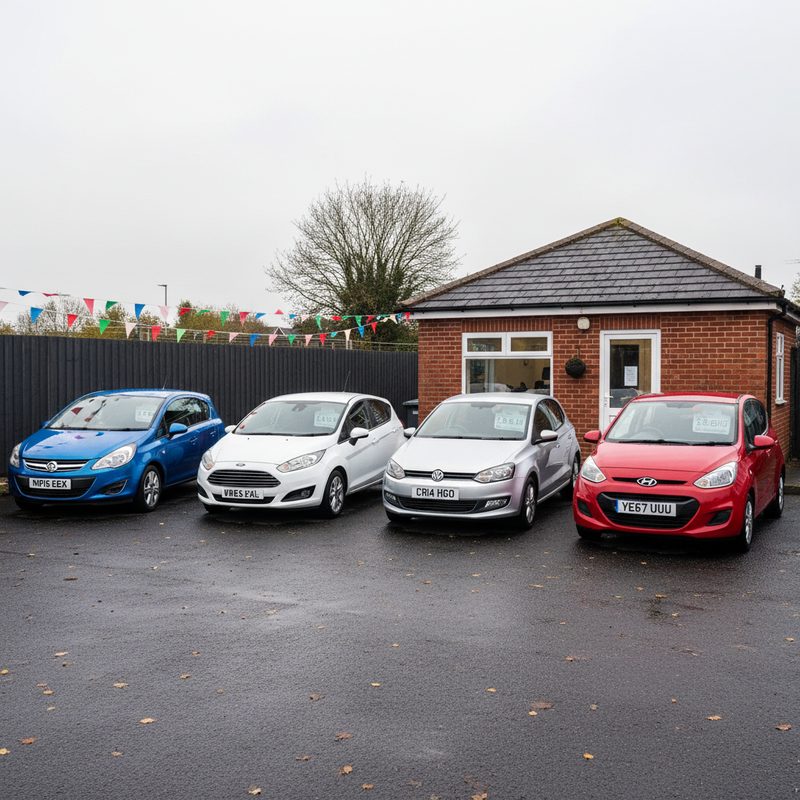
Best First Cars Under £3500 — Dave Recommends
At three and a half grand, the quality improvements start to get serious. On his mechanic hat and examines five top first car picks from the inside out -- engines, gearboxes, suspension, the lot.
I have spent twenty-odd years peering under bonnets, crawling underneath cars on ramps, and diagnosing everything from a dodgy lambda sensor to a catastrophic head gasket failure. That experience has given me a very particular way of looking at cars -- I do not care much about what colour it is or whether it has fancy alloys. I care about whether the engine is going to last, whether the gearbox shifts cleanly, and whether the suspension geometry is going to stay where the factory put it.
At £3,500, you hit a budget where the mechanical quality of the cars available takes a genuine step up. You are moving away from tired, high-mileage examples and into the territory of well-maintained vehicles with plenty of engineering life left in them. As someone who has rebuilt more engines than I care to count, I can tell you that the difference between a £2,000 car and a £3,500 car is not just cosmetic -- it goes right down to the condition of the bearings, the compression ratios, and the integrity of the seals.
Let me take you through five cars that I would be happy to see on my ramp, and explain exactly what makes each one mechanically sound.
Ford Fiesta (Mk7, 2008-2017) -- The Engineering Benchmark
The Mk7 Fiesta is one of those cars that engineers love because Ford got so many of the fundamentals right. The chassis geometry is superb -- the MacPherson strut front suspension and twist-beam rear setup was tuned by the same team that did the Focus ST, and the result is a car that handles with a precision that embarrasses some cars costing twice as much.
At £3,500, you are looking at 2013-2015 models, likely with the 1.25 Duratec petrol engine (82bhp) or the 1.0 EcoBoost (100-125bhp). From a mechanical standpoint, both are excellent choices, but they are very different beasts.
The 1.25 Duratec is a naturally aspirated four-cylinder that has been in production in various forms since the mid-1990s. It is one of the most proven engines in Ford's history. No turbo to fail, no intercooler to leak, no boost pipes to split. The timing is chain-driven, so there is no belt replacement to budget for. This engine will do 150,000 miles without breaking a sweat if you change the oil regularly. From under the bonnet, it is a mechanic's dream -- everything is accessible, everything is logical, and parts cost next to nothing.
The 1.0 EcoBoost is more modern and more efficient, but it introduces turbocharger complexity. The early versions (2012-2014) had a known coolant hose issue that could lead to overheating and, in severe cases, engine damage. Ford issued a service action to address it, so check that any car you look at has had the work done. The degas hose (the plastic pipe connecting the coolant reservoir to the engine) was the culprit, and the fix involves a revised metal pipe. If the recall has been completed, the EcoBoost is a brilliant engine. If it has not, walk away.
The gearbox on both variants is Ford's B6 five-speed manual. It has a light, precise shift action and is mechanically robust. Check for any crunchiness going into second or third gear -- synchromesh wear is the only common gearbox issue, and it typically manifests at 80,000-100,000 miles on cars that have been driven hard.
insurance groups range from 3-7 for the 1.25 and 10-16 for the EcoBoost. Fuel economy is 45-50mpg for the 1.25 and 50-58mpg for the EcoBoost.
Under the bonnet checklist:
- Check coolant level and look for mayo on the oil filler cap
- Listen for timing chain rattle on cold start (rare but possible)
- EcoBoost: confirm degas hose recall completed
- Check for oil leaks around the rocker cover gasket
- Test the clutch -- bite point should be mid-travel, not at the top
Toyota Yaris (Mk3, 2011-2020) -- The Reliability Machine
If I had to name the most mechanically sound small car on the market, the Mk3 Yaris would be right at the top of the list. Toyota builds these things to a standard that borders on over-engineering, and the result is a car that simply refuses to break down.
At £3,500, you are finding 2013-2015 models with 40,000-60,000 miles. The 1.0 VVT-i engine (69bhp) and the 1.33 VVT-i (99bhp) are both available. The 1.33 is the better choice if you can find one in budget -- it is more relaxed at speed and the extra 30 horsepower makes a noticeable difference on hills and dual carriageways.
Both engines use Toyota's VVT-i variable valve timing system, which optimises power delivery and fuel efficiency across the rev range. It is a mature, proven technology with virtually no reliability concerns. The timing is chain-driven on both engines, and Toyota's chain tensioners are among the Most Reliable in the industry.
What impresses me most about the Yaris from a workshop perspective is the build quality of the ancillaries. The alternator, water pump, starter motor, and power steering pump on a Yaris typically last the life of the car. On many European rivals, these components start failing at 80,000-100,000 miles. On a Yaris, they routinely last 150,000 miles or more. That translates directly into lower maintenance costs for the owner.
The suspension setup is conventional -- MacPherson struts at the front, torsion beam at the rear -- but the component quality is high. The rubber bushes use a harder compound than most rivals, which means they last longer before perishing. The anti-roll bar links and drop links are the most common wear items, but they are cheap (£15-£25 per side for parts) and easy to replace.
insurance groups sit at 3-7 for the 1.0 and 6-10 for the 1.33. Fuel economy is 50-55mpg for the 1.0 and 48-53mpg for the 1.33.
Under the bonnet checklist:
- Check oil level (the 1.33 can use a small amount of oil between services)
- Inspect the drive belt for cracking or glazing
- Check brake fluid colour (should be clear/light yellow, not dark brown)
- Listen for any exhaust blowing -- the rear section corrodes first
- Inspect the battery terminals for corrosion
Volkswagen Polo (Mk5, 2009-2017) -- German Engineering On A Budget
The Mk5 Polo is essentially a shrunken Golf, and it benefits from the same engineering rigour that makes the Golf the class benchmark. The body shell is stiffer than most rivals, the panel gaps are tighter, and the overall fit and finish is a step above the competition.
At £3,500, expect 2013-2015 models with 45,000-65,000 miles. The 1.0 MPI (60bhp or 75bhp) and the 1.2 TSI (90bhp or 110bhp) are the main engine choices. From a longevity standpoint, the 1.0 MPI is the safer bet -- it is a simple, naturally aspirated three-cylinder with no turbo and minimal complexity. The 1.2 TSI is the more refined engine but introduces timing chain tensioner concerns that I need to flag.
The 1.2 TSI engine in its EA111 form (used in Polos up to about 2014) had a known issue with the timing chain stretching and the tensioner failing. When this happens, the chain jumps and the engine suffers catastrophic valve-to-piston contact. It is not a subtle failure -- it kills the engine. VW revised the chain and tensioner in later production, and the EA211 engine (from around 2014-2015) resolved the issue entirely. If you are looking at a 1.2 TSI Polo, check which engine code it has and whether the chain and tensioner have been replaced. A VW dealer can tell you from the chassis number.
The gearbox is solid on all variants. The five-speed manual is precise and well-weighted. The DSG (dual-clutch automatic) is available on some models -- it is a good gearbox but requires a fluid change every 40,000 miles and the mechatronic unit can fail expensively. For a first car is £30-£130 depending on the year.
Under the bonnet checklist:
- Check oil level (these engines are frugal with oil but check anyway)
- Inspect the auxiliary drive belt for wear
- Check the exhaust manifold for cracks (listen for a ticking noise when cold)
- Look at the brake fluid reservoir -- should be between min and max
- Inspect the battery -- Japanese batteries often last well but check the date
Skoda Fabia (Mk2, 2007-2014) -- The Practical Workhorse
The Fabia is the car I recommend to anyone who needs a bit more space than a city car but does not want the running costs of something larger. It is built on VW Group's proven PQ25 platform and shares engines and transmissions with the Polo and Ibiza, but it offers a bigger boot (315 litres) and more rear legroom than either.
At £3,500, expect 2012-2014 models with 40,000-65,000 miles. The 1.2 12v petrol (60bhp or 70bhp) and the 1.2 TSI (86bhp or 105bhp) are the main choices. The same timing chain caveat applies here as with the Polo -- the EA111 1.2 TSI engine needs its chain and tensioner history checked carefully.
The naturally aspirated 1.2 12v is the simpler and more reliable option. It is not fast, but it is adequate for daily driving and sits in very low insurance groups (2-6). The engine is a three-cylinder unit that has a slightly agricultural character -- it vibrates a bit at idle and makes a distinctive thrum under acceleration -- but mechanically it is tough and long-lasting.
Skoda builds the Fabia with a focus on practicality that other brands overlook. The boot is not just big -- it is well-shaped, with a flat floor and a wide opening. There are clever storage solutions throughout the cabin: a ticket holder on the A-pillar, an ice scraper in the fuel filler flap, and a double-sided boot floor that is carpet on one side and wipe-clean on the other. These details cost nothing to maintain but make daily life genuinely easier.
The Fabia's ride quality is comfort-oriented, which suits UK roads well. The suspension absorbs potholes without crashing and remains composed over speed bumps. It is not a sporty car and does not pretend to be, but the steering is accurate enough and the brakes are progressive and confidence-inspiring.
Under the bonnet checklist:
- 1.2 TSI: timing chain rattle check is essential
- 1.2 12v: check for oil consumption (these can use oil, especially above 60k miles)
- Inspect the coolant expansion tank for cracks (common on VW Group cars of this era)
- Check the condition of the spark plugs
- Look for any signs of rodent damage to wiring (the Fabia's engine bay is a popular nesting spot)
What Quality Improvements Does £3,500 Bring
Compared to the £2,500-£3,000 bracket, here is what changes:
- Access to the Ford Fiesta and VW Polo: two of the best superminis ever made, previously just out of reach
- Lower mileage across the board: typically 40,000-65,000 rather than 55,000-80,000
- Better mechanical condition: less wear on engines, gearboxes, and suspension components
- More remaining tyre and brake life: fresh MOT cars at this price often have decent consumables
- Higher specification trims: air conditioning, cruise control, and parking sensors become common
Dave's Mechanic Verdict
If I were advising my own apprentice on which car to buy at £3,500, I would point them towards the Toyota Yaris for pure reliability or the Ford Fiesta for the best balance of fun and sensibility. The Polo is the quality choice if you verify the timing chain history. The Mazda 2 is the engineer's favourite for its simplicity. And the Fabia is the practical one for anyone who needs to carry more than a rucksack.
Whatever you choose, do not buy it blind. A visual inspection tells you a lot, but it cannot tell you everything. Before you hand over your money, run the registration through Dave's vehicle check. Outstanding finance, write-off history, mileage discrepancies, stolen markers -- these are things that no amount of peering under the bonnet will reveal. A proper history check is as important as a mechanical inspection, and at £3,500, you owe it to yourself to buy with full knowledge. I have seen too many people learn this lesson the hard way.
Check any car with Dave
Get Dave's free AI-powered vehicle check before you make a decision.