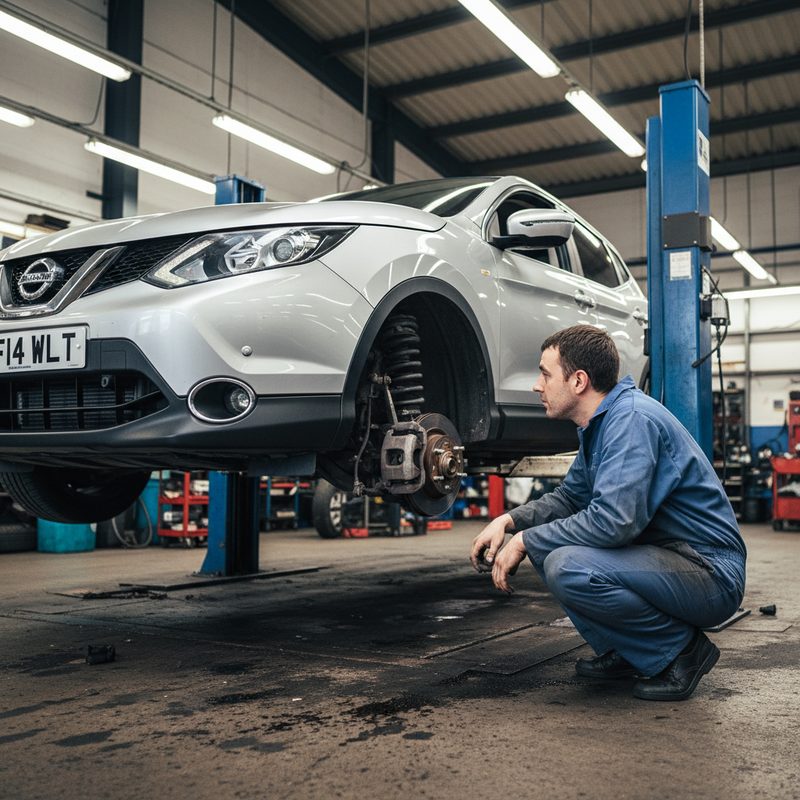
Anti-Roll Bar Link Worn MOT Advisory: What It Means
Anti-roll bar links (drop links) are one of the most common MOT advisories, and one of the cheapest to fix. Here's what they do, repair costs, DIY difficulty, and how long they last.
What Are Anti-Roll Bar Links?
Anti-roll bar links, commonly called drop links: are short metal rods with ball joints at each end that connect the anti-roll bar (also called a sway bar or stabiliser bar) to the suspension strut or hub assembly. Every car has them, typically two on the front axle and two on the rear.
Their job is simple but important: they transfer force from the anti-roll bar to the suspension, reducing body roll when you turn corners. Without functioning drop links, the anti-roll bar can't do its job effectively, and the car leans more in corners and feels less stable.
Drop links are a wear item: the ball joints at each end are enclosed in rubber boots filled with grease. Over time, the rubber perishes, water and grit get in, the grease washes out, and the joint develops play. This is completely normal and affects every car eventually.
How Serious Is a Drop Link Advisory?
Not very: in most cases. A worn drop link MOT advisory means the tester detected play or movement in the ball joint beyond acceptable limits, but not enough to constitute an immediate safety hazard (which would be a fail).
Advisory vs Fail
| Condition | MOT Result |
|---|---|
| Slight play in drop link ball joint | Advisory |
| Excessive play, joint close to disconnecting | Fail |
| Drop link completely disconnected | Fail |
| Rubber boot split but joint still tight | Advisory |
| Rust on drop link body (but joint OK) | Advisory (if it weakens the structure) |
An advisory means "this needs attention soon", typically within the next 6 to 12 months before it deteriorates to a fail. You're safe to drive on an advisory, but the handling is slightly compromised and you'll likely hear clunking noises over bumps.
Important: A worn drop link won't cause sudden catastrophic failure. It degrades gradually. But ignoring it for too long leads to accelerated tyre wear (uneven wear patterns), increased body roll, and eventually a failed MOT at the next test.
How Much Does It Cost to Fix?
Drop links are one of the cheapest suspension repairs on any car:
| Service | Cost (Independent Garage) | Cost (Main Dealer) |
|---|---|---|
| Single drop link replacement | £40 to £70 | £60 to £100 |
| Front pair (both sides) | £70 to £120 | £100 to £180 |
| Rear pair (both sides) | £60 to £100 | £90 to £160 |
| All four (front and rear) | £120 to £200 | £180 to £320 |
Parts cost £8 to £25 per link depending on brand and vehicle. Labour is typically 30 to 45 minutes per pair. This is genuinely one of the cheapest MOT fixes you'll encounter.
Price by Common Car Model
| Car | Front Pair (Parts + Labour) |
|---|---|
| Ford Fiesta / Focus | £70 to £100 |
| VW Golf / Polo | £80 to £120 |
| BMW 1/3 Series | £90 to £140 |
| Vauxhall Corsa / Astra | £65 to £95 |
| Toyota Yaris / Corolla | £70 to £110 |
| Nissan Qashqai | £80 to £120 |
Can I DIY This?
Yes: drop link replacement is one of the most accessible DIY suspension jobs. Difficulty rating: 3/10 (with basic tools).
Tools You'll Need
- Jack and axle stands (never work under a car supported only by a jack)
- Socket set (typically 15mm, 16mm, or 17mm depending on car)
- Spanner or open-ended wrench for the ball joint stem
- Penetrating oil (WD-40 or PlusGas), essential for seized nuts
- Torque wrench (for final tightening to spec)
Step-by-Step Process
- Safely jack up the car and support on axle stands. Remove the wheel for better access
- Spray penetrating oil on both nuts (top and bottom of the drop link), let it soak for 10 minutes
- Hold the ball joint stem with an open-ended wrench or Allen key (prevents the stem spinning while you undo the nut)
- Remove the bottom nut connecting the drop link to the hub/strut
- Remove the top nut connecting the drop link to the anti-roll bar
- Fit the new drop link: hand-tighten both nuts
- Torque to specification (check your car's manual, typically 40 to 60 Nm)
- Lower the car and test drive, the clunking should be gone
Total time: 30 to 60 minutes per pair for a first-timer, 15 to 20 minutes for experienced DIYers.
Common DIY problem: Seized nuts. If the nut won't budge, apply more penetrating oil and wait. If it's completely seized, you may need to cut the old drop link off with an angle grinder or hacksaw, the old link is being replaced anyway.
Parts Sources
- Halfords: Convenient but pricier, £15 to £25 per link
- Euro Car Parts / GSF: Better prices, £8 to £15 per link
- Online (eBay, Amazon): Budget options from £5 to £10 per link, but stick to known brands (Lemforder, Meyle, TRW, Febi)
Symptoms of Worn Drop Links
If you're experiencing any of these, your drop links may need replacing:
- Clunking or knocking over speed bumps and potholes, the most common symptom. Sounds like a metallic rattle from the front (or rear) suspension
- Rattling over rough roads: particularly noticeable at low speeds where other noise doesn't mask it
- Increased body roll in corners, the car feels less stable and leans more than usual
- Uneven tyre wear: worn drop links can cause the wheel alignment to drift slightly, creating uneven wear patterns
- Steering feels vague: particularly when turning into corners at moderate speed
- Visible play: if you grab the drop link and can move it with your hand (engine off, car on the ground), it's worn
How Long Do Drop Links Last?
Drop link lifespan varies significantly based on driving conditions:
| Condition | Typical Lifespan |
|---|---|
| Motorway-dominated driving | 60,000 to 80,000 miles |
| Mixed urban/motorway | 40,000 to 60,000 miles |
| Urban with speed bumps | 30,000 to 50,000 miles |
| Poor road conditions | 25,000 to 40,000 miles |
| Track day use | 10,000 to 20,000 miles |
UK roads, with their abundance of speed bumps, potholes, and degraded surfaces, mean most cars need drop links every 40,000 to 60,000 miles on the front axle. Rears last longer as they bear less load.
Budget quality links (£5 to £8 each) may only last 20,000 to 30,000 miles. OEM-quality brands (Lemforder, TRW, Meyle HD) typically last 40,000 to 60,000 miles. The price difference is negligible, always buy quality.
Prevention
You can't prevent drop link wear. It's a normal consumable item. But you can extend their life:
- Avoid speed bumps at speed: take them slowly. The impact force multiplies exponentially with speed
- Choose quality replacement parts: Lemforder and TRW are OEM-level suppliers
- Check them during services: ask your mechanic to inspect drop links at every service. Catching play early prevents damage to other components
Related MOT Guides
For other common suspension advisories, Dave covers:
- Track rod end worn: cost and safety
- Rear coil spring corroded
- Steering rack worn
- Rear brake disc worn
Check your car's full MOT history for any recurring suspension advisories, if the same items appear year after year, it suggests either poor-quality replacement parts or an underlying alignment issue worth investigating.