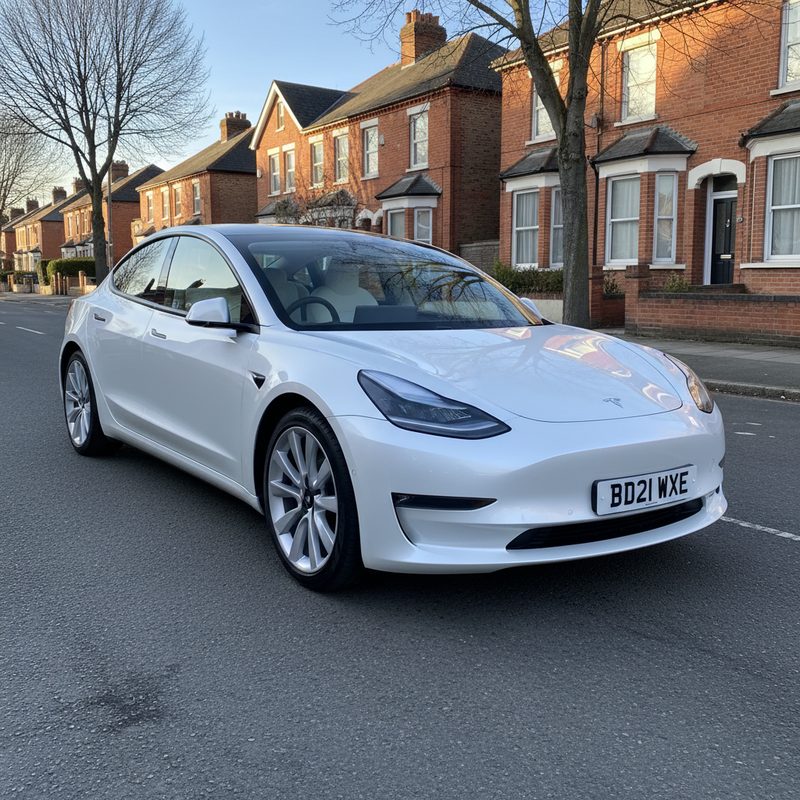
Tesla Model 3 Real Range UK Winter Driving
Tesla Model 3 winter range drops 30 to 44% in UK cold. Real-world figures, why it happens, charging speed impact, and 7 tips to maximise your winter miles.
The Range Promise vs UK Reality
Tesla's official WLTP figures look impressive, 305 miles for the Standard Range Plus (now renamed "Model 3") and 374 miles for the Long Range. But WLTP testing happens in controlled laboratory conditions at 23°C with minimal climate control demand. A British winter, 3°C, driving rain, heater blasting at 21°C, heated seats on, and headlights burning for 16 hours of darkness, tells a very different story.
This isn't a Tesla-specific problem. Every EV loses range in cold weather. But the Model 3 is the UK's most popular electric car, and the gap between the showroom promise and the January reality catches first-time EV buyers off guard. Based on real UK owner data from forums, Tesla owner clubs, and Dave's own experience, here's what you'll actually get.
Real Winter Range by Model
| Model (Battery Size) | WLTP Range | Real UK Winter Range | Winter Loss |
|---|---|---|---|
| Standard Range Plus / Model 3 (60 kWh usable) | 305 miles | 170 to 210 miles | 31 to 44% |
| Long Range AWD (75 kWh usable) | 374 miles | 220 to 270 miles | 28 to 41% |
| Performance (75 kWh usable) | 352 miles | 200 to 250 miles | 29 to 43% |
These figures assume mixed driving (urban, suburban, and some motorway) with the cabin heated to 20°C and typical UK winter temperatures of 0 to 7°C. They represent the range you'd realistically achieve on a November-to-March drive across varied conditions.
Motorway-only driving in winter drops range by an additional 10 to 15% because of sustained high power draw at 70 mph, constant heating demand, and aerodynamic drag. A Standard Range Plus doing a motorway-only winter journey might achieve as little as 150 to 170 miles before needing a charge.
City-only driving in winter is kinder, lower speeds mean lower energy consumption per mile, and regenerative braking recovers more energy. Expect 190 to 220 miles from the Standard Range in city conditions.
Why Cold Weather Kills Range
Three factors combine to reduce your usable range in cold conditions, and understanding them helps you manage expectations and optimise:
1. Battery Chemistry: £0 to Fix, Just Physics
Lithium-ion batteries are less efficient when cold. Below 10°C, the internal chemical resistance of the cells increases, reducing the amount of energy the battery can deliver per cycle. Tesla's battery management system (BMS) pre-heats the battery pack to improve performance, but the pre-heating process itself consumes 2 to 5 kWh of energy, roughly 10 to 25 miles of range before you've even moved.
The Model 3 uses NCA (nickel-cobalt-aluminium) chemistry in the Long Range/Performance and LFP (lithium iron phosphate) in the Standard Range (post-2021). LFP batteries are particularly sensitive to cold. They lose 5 to 10% more range in winter compared to NCA at the same temperature. This means the Standard Range Plus with LFP chemistry can see winter losses at the higher end of the 31 to 44% range.
2. Cabin Heating: The Biggest Single Drain
Unlike a petrol car that uses waste engine heat (essentially free), an EV must generate all cabin heat electrically. Pre-2021 Model 3s used a resistive heater that drew 3 to 6 kW continuously, equivalent to running two domestic fan heaters simultaneously. Over a 90-minute commute, that's 4.5 to 9 kWh, or roughly 25 to 45 miles of range consumed purely by heating.
Post-late-2020 Model 3s use a heat pump system that's roughly 2 to 3× more efficient than resistive heating. The heat pump draws 1.5 to 3 kW for the same cabin temperature, saving approximately 15 to 25 miles of range on a typical winter commute compared to the resistive system.
Key buying tip: If buying a used Model 3 for UK use, strongly prefer a 2021+ model with heat pump. The winter range difference is significant, equivalent to an extra 15 to 25% usable range in cold conditions, which can be the difference between making it home and needing an emergency charge stop.
3. Tyre Rolling Resistance and Aerodynamics
Cold temperatures increase tyre rubber stiffness, which raises rolling resistance by approximately 3 to 5%. Winter tyres (recommended for sub-7°C driving) increase rolling resistance further, budget an additional 3 to 5% range loss when running winter-compound tyres. The total tyre-related winter penalty is approximately 15 to 25 miles on the Long Range and 10 to 15 miles on the Standard Range.
Cold, denser air also increases aerodynamic drag slightly at motorway speeds, a minor factor (1 to 2%) but it compounds with everything else.
How Charging Changes in Winter
Cold batteries don't just deliver less range. They also charge more slowly. The BMS limits charge rate to protect cold cells from lithium plating (which permanently damages capacity).
Supercharger Performance in Cold Weather
| Battery Temperature | Peak Charge Rate | Time: 10% → 80% |
|---|---|---|
| Warm (25°C+) | 250 kW (V3 Supercharger) | 25 to 30 minutes |
| Cool (10°C) | 120 to 180 kW | 30 to 40 minutes |
| Cold (5°C) | 80 to 120 kW | 40 to 55 minutes |
| Very cold (-5°C) | 50 to 80 kW | 55 to 75 minutes |
Essential tip: Use Tesla's "Navigate to Supercharger" feature in the sat-nav. When you route to a Supercharger, the car automatically pre-heats the battery pack using waste motor heat and the battery heater during the drive. This can double or triple your initial charge rate compared to arriving with a cold battery. The pre-conditioning uses 1 to 3 kWh of energy but saves 15 to 20 minutes of charging time, always worth it.
Home Charging in Winter
Home charging on a 7 kW wallbox is largely unaffected by temperature. It takes 7 to 9 hours for a Standard Range from 20% to 100% regardless of weather. The slower charge rate means the battery has time to warm gradually during charging. If you have home charging, winter range is a minor inconvenience rather than a genuine problem, just plug in every night.
Home charging costs approximately £8 to £12 for a full charge on the Standard Range using overnight tariffs (Octopus Go, Economy 7). That's roughly 4 to 5p per mile even in winter, compared to 14 to 16p per mile for an equivalent petrol car.
For finding public charging points, Zap-Map is the essential UK tool. It shows real-time availability, connector types, and charge speeds for every public charger in the country.
Real-World Winter Scenarios
Daily Commute (30 Miles Round Trip)
Even in the worst UK winter conditions, the Standard Range Plus handles a 30-mile commute without any anxiety. You'll consume 40 to 55 miles of rated range for a 30-mile trip (due to heating and cold-battery inefficiency), but starting each morning with a full charge from your home wallbox means you'll have 150 to 170 miles of winter range remaining. You could skip charging for 3 consecutive days and still have range to spare.
Verdict: No range concerns whatsoever. Plug in overnight, leave preconditioned, arrive warm.
Motorway Run (150 Miles)
This is where winter range anxiety becomes real for Standard Range owners. A full charge gives you 170 to 210 miles of real winter range, and a 150-mile motorway run at 70 mph is the worst-case scenario for energy consumption. You'll arrive with 10 to 20% battery: enough to reach your destination, but uncomfortably close to the reserve if there's a diversion or delay.
Verdict: Plan a 10-minute Supercharger stop at the 80 to 100 mile mark if you want peace of mind. The Long Range model makes this journey comfortable without stopping.
Long Trip (300+ Miles)
You'll need one or two Supercharger stops regardless of which Model 3 variant you have. Budget 25 to 45 minutes per stop in winter (longer than summer because of cold-battery charge rates). The Long Range typically needs one stop; the Standard Range needs two.
Tesla's Supercharger network coverage across the UK is now comprehensive. You're rarely more than 50 miles from a Supercharger on major routes. The sat-nav plans stops automatically and accounts for weather-adjusted range.
Verdict: Absolutely doable, but add 45 to 90 minutes to your journey time versus summer. Leave preconditioned and use seat heaters to reduce climate system draw.
Tips to Maximise Winter Range
- Pre-condition the cabin while plugged in: schedule departure time in the Tesla app. The car heats the cabin and battery using mains power, preserving 15 to 25 miles of battery range
- Use seat and steering wheel heaters instead of cabin heating: seat heaters use 75W per seat versus 1,500 to 3,000W for the climate system. Three heated seats consume less than 5% of the energy of heating the entire cabin
- Set climate to 19°C, not 22°C: every degree above 19°C costs approximately 3 to 5 miles of range on a 60-minute drive
- Keep tyre pressures correct: cold air contracts, dropping pressures by 1 to 2 PSI per 10°C temperature drop. Check monthly in winter and inflate to the cold-weather specification on the door jamb (typically 42 PSI all round)
- Avoid very short trips: the battery and cabin never warm up properly on trips under 5 miles, wasting energy on repeated cold starts. If possible, combine short errands into one longer trip
- Use Chill Mode for motorway driving: reduces acceleration response but smooths power delivery, reducing peak consumption
- Park in a garage: even an unheated garage keeps the battery 5 to 10°C warmer than outside, which can preserve 10 to 20 miles of morning range
Is the Standard Range Enough for the UK?
For most UK drivers doing under 80 miles per day with home charging, yes, absolutely. The Standard Range handles British winter comfortably for daily commuting, school runs, shopping, and weekend trips. You'll charge overnight, leave with 170 to 210 miles of winter range, and use 30 to 60 miles on a typical day. No range anxiety, no mid-journey charging, no compromise.
The Long Range is worth the £6,000 to £8,000 premium if:
- You regularly drive 150+ miles in a single journey
- You don't have reliable home charging (public charging is less predictable)
- You want the comfort margin of 220 to 270 winter miles versus 170 to 210
- You frequently drive on motorways (highest energy consumption scenario)
Compare the total cost of EV ownership against petrol equivalents. Even with winter range loss, electricity costs roughly 4 to 5p per mile versus 14 to 16p for a petrol car, the EV saves approximately £1,000 to £1,500/year in fuel costs at 10,000 miles/year.
Dave's Winter Range Verdict
Expect 30 to 40% less range than WLTP in a UK winter. That's not a flaw. It's physics, and it affects every EV equally. The Tesla Model 3 handles it better than most because of the excellent Supercharger network, the heat pump (2021+ models), and the sophisticated battery pre-conditioning system.
Plan for winter range from day one: buy a 2021+ model with the heat pump if possible, install a home wallbox (£800 to £1,200 after OZEV grant), precondition before every cold-weather drive, and use Zap-Map to know where your backup chargers are. The Model 3 remains one of the best EVs for real-world UK driving, cold weather included. Check the MOT history (yes, EVs need MOTs from 3 years old) and verify battery health data on the Tesla app before buying any used Model 3.