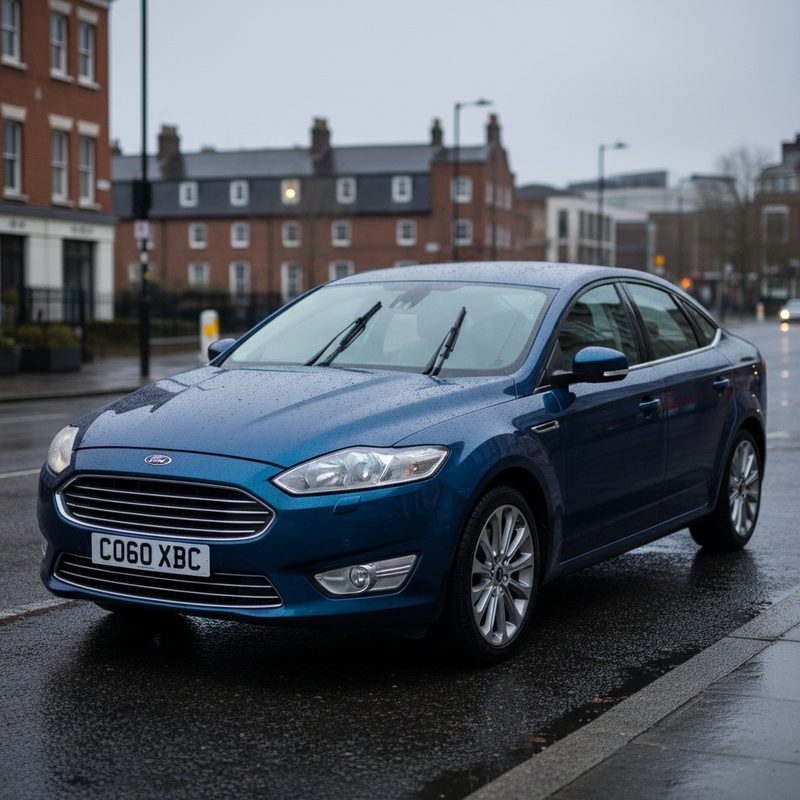
2010 Ford Mondeo Mk4 — Bargain Motorway Cruiser or Money Pit
You can buy a Mondeo Mk4 for the price of a budget smartphone. The question is whether the MOT bills will cost more than the car itself — Dave has the data.
The Forgotten Bargain
The Ford Mondeo Mk4 (2007–2014) has become almost embarrassingly cheap to buy, and that represents either a brilliant opportunity or a potential money pit depending entirely on the specific car you choose. A 2010 example with around 90,000 miles costs £1,500–£2,500 for a tidy privately-owned car, while high-mileage ex-fleet examples with 130,000 miles or more regularly dip below £1,000. For that money you get a full-size family car with a brilliant chassis, genuinely impressive ride quality, more interior space than most people need, and proven mechanicals from one of the world's largest car manufacturers. The Mondeo has always lived in the shadow of the BMW 3 Series and Audi A4 in terms of desirability, but it matches or exceeds both for pure driving enjoyment and beats them comprehensively on maintenance costs. The depreciation curve has been brutal for Mondeo owners — but for used car buyers, that brutality is your greatest advantage.
At 15 years old and beyond, the national average MOT failure rate sits at approximately 39% across all vehicle classes, and the Mondeo Mk4 tracks close to this figure. The Mondeo's larger size means that when things do go wrong, the repair bills are correspondingly larger than those on a Fiesta or Focus — bigger brake discs cost more to replace, the complex multi-link rear suspension has more components to wear out, and the exhaust system on a car this size uses more material and is more expensive to fabricate. However, the fundamental engineering is sound, the engines are well-proven across multiple Ford platforms and millions of vehicles worldwide, and there are no catastrophic design failures lurking in the data. This is a car that wears out rather than breaks down, and that distinction matters enormously when you are buying on a tight budget.
The Mondeo Mk4 was available as a five-door hatchback, four-door saloon, and estate, with trim levels from Edge through Zetec, Titanium, and Titanium X. The Titanium is the sweet spot — it adds climate control, cruise control, parking sensors, heated seats on many examples, and a significantly better stereo than the Zetec. The estate version is particularly compelling for families, offering an enormous 540-litre boot that expands to nearly 1,740 litres with the rear seats folded. If you need space above all else, the Mondeo estate is hard to beat at any price.
Engine Choices — The Critical Decision
2.0 TDCi (140 bhp) — The Fleet Favourite
This is the engine that the vast majority of Mondeo Mk4 buyers should consider, and it accounts for the largest proportion of surviving cars on the used market. The 2.0-litre TDCi produces 140 bhp and 320 Nm of torque, which is more than adequate for a car of this size and weight. Real-world fuel economy sits at 45–50 mpg on a steady motorway cruise, dropping to 38–42 mpg in mixed driving, and the engine pulls strongly from low revs in a way that makes motorway overtaking effortless. The engine is well-proven across the Focus, C-MAX, S-MAX, Galaxy, and Volvo S40/V50, which means parts are plentiful and every diesel specialist in the country knows the unit inside out. The weak point is the DPF — if the previous owner did primarily short urban trips, the DPF may be partially or fully blocked. A new DPF costs £600–£1,000 fitted, and a DPF delete is illegal and will cause an MOT failure. Check the exhaust for excessive blue or black smoke on startup and during hard acceleration, and ask the seller about the car's typical driving pattern. A motorway-run Mondeo with a clean DPF is a genuinely excellent long-distance car.
1.6 EcoBoost (160 bhp) — The Modern Petrol Option
Available from 2011 onwards, the 1.6 EcoBoost turbo petrol is a surprisingly capable engine that makes the Mondeo feel considerably more modern than the 2.0 Duratec petrol it replaced. It produces 160 bhp and 240 Nm of torque, returns 38–42 mpg in mixed driving, and avoids all the diesel-related maintenance headaches — no DPF, no expensive fuel injectors, no glow plug replacements. The timing belt needs replacing every five years or 75,000 miles at a cost of £350–£450, which is a significant scheduled maintenance item that must be up to date. Fewer are available on the used market than the TDCi, but if you find one with a verified belt change history, it is an excellent choice that combines reasonable economy with petrol simplicity.
2.0 Duratec Petrol (145 bhp) — Best Avoided
The 2.0 naturally aspirated petrol is thirsty at 28–32 mpg in the real world, underpowered for a car this heavy, and no cheaper to maintain than the diesel. There is no compelling reason to buy one unless it is exceptionally cheap and you specifically cannot tolerate diesel engines. The fuel costs alone will exceed those of the TDCi by £600–£800 per year at average mileage, which quickly erodes any purchase price advantage.
2.2 TDCi (175 bhp) — The Performance Diesel
The 2.2 TDCi produces 175 bhp and significantly more torque than the 2.0, making the Mondeo feel properly quick. It returns slightly lower economy at 40–45 mpg but rewards with a driving experience that approaches sports saloon territory. Fewer are available and they tend to be higher-mileage ex-fleet cars, but if you find a well-maintained example, it transforms the Mondeo from a comfortable cruiser into something genuinely exciting.
Dave's pick: 2.0 TDCi 140 if you do motorway miles. 1.6 EcoBoost if you want petrol simplicity and can confirm the timing belt history.
Known Faults
Dual Mass Flywheel — The Big-Ticket Item
The 2.0 TDCi uses a dual mass flywheel that absorbs the diesel engine's inherent vibration, and it is the single most expensive wear item on the Mondeo Mk4. The DMF typically wears out between 80,000 and 120,000 miles, though aggressive driving, frequent town use, and heavy loads accelerate the wear. Symptoms are distinctive — a metallic rattling noise at idle that disappears when the clutch pedal is depressed, and juddering when pulling away in first or second gear, particularly on inclines. Replacement cost runs to £500–£800 for the DMF and clutch together at an independent garage, and you should always replace the clutch at the same time because the labour to access the flywheel is identical and a new clutch adds only £100–£150 to the parts cost. Our component lifespan data shows clutches lasting 60,000–100,000 miles, and on the heavier Mondeo they rarely outlast the DMF. Budget for this work if the car has not already had it done — it is a when, not an if, on any TDCi Mondeo.
Power Steering Pump Failure
The electric power steering pump can fail on the Mondeo Mk4, particularly on 2007–2010 model year cars. The warning signs are progressive — you may notice the steering becoming heavier than usual at low speeds, particularly during parking manoeuvres, followed by a power steering warning light on the dashboard. In some cases the failure is sudden, leaving you with completely unassisted steering that is extremely heavy at low speeds. A replacement pump costs £400–£700 depending on whether you fit a new or reconditioned unit, and this is a significant bill on a car worth £1,500. During any test drive, pay careful attention to the steering weight at all speeds and particularly during slow-speed manoeuvring — any inconsistency, heavy spots, or warning lights are immediate red flags.
Suspension Components — The Multi-Link Rear
The Mondeo Mk4 uses a sophisticated multi-link rear suspension system that provides outstanding ride quality and handling balance, but the numerous bushes, rust is becoming a genuine concern. The critical areas to inspect are the front wings behind the wheel arch liners, where stone chips and trapped moisture combine to start the corrosion process; the sill edges, particularly beneath the rear doors; and the rear wheel arches, where the inner and outer panels meet. Our data rates corrosion at 1.8x severity weighting, and structural corrosion carries an even higher weight of 2.0x because of the safety implications. On a car worth £1,500, serious structural rust means it is not economically viable to repair — corrosion work ranges from £200 for minor cosmetic bubbling to £2,500 or more for structural sill and subframe repairs. The advisory-to-failure conversion rate for corrosion is 60–85%, so any rust advisory should be treated as a repair needed within the next 12 months.
Exhaust System Corrosion
The centre section and flexi-joint of the exhaust system rot on the Mondeo Mk4, particularly on cars that do short trips where the exhaust never fully heats up and where condensation accumulates inside the system. An MOT history typically shows a predictable pattern of wear-related failures:
- Ford running cost comparisons across the range or negotiation tips, Dave has dedicated guides. Check the car's full history on HonestJohn for owner feedback on specific engine variants, and always pull the MOT history before viewing.
Useful links: Check MOT history | DVLA vehicle check | Honest John owner reviews | AutoTrader Mondeo listings | Euro NCAP safety rating
Check 2010 Ford Mondeo, instantly with Dave's free vehicle intelligence report.
Check any Ford Mondeo instantly with Dave's free vehicle intelligence report