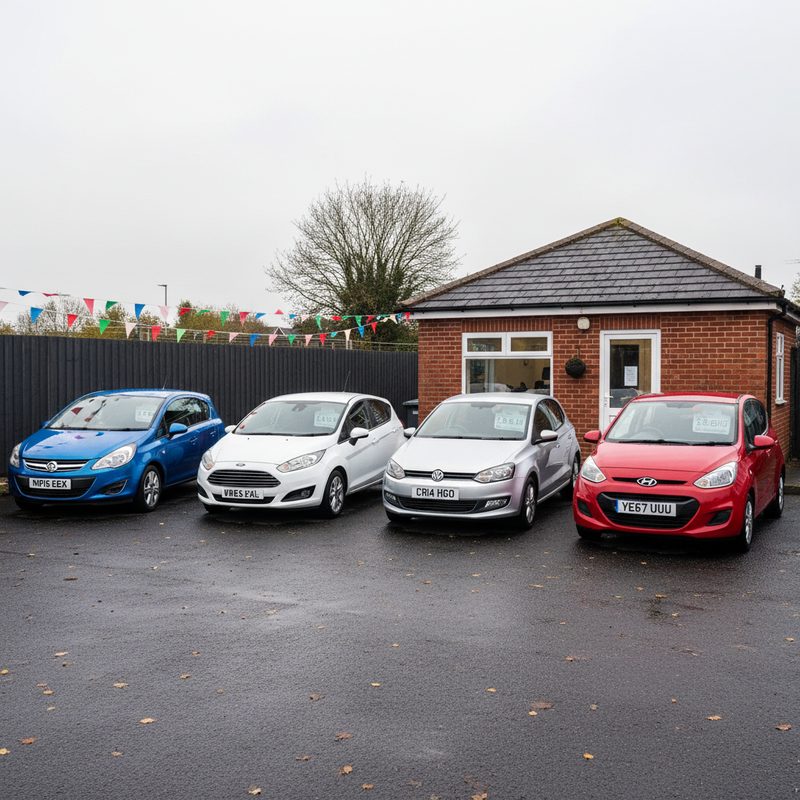
Best First Cars Under £7000 — Dave Recommends
Seven thousand pounds puts you in nearly-new territory for a first car. His authoritative expert verdict on five outstanding choices that offer remarkable quality, technology and value.
Seven thousand pounds represents the upper boundary of what most people would consider a sensible First Cars sit at 8-12, which is reasonable for a car of this quality.
The infotainment system is Volkswagen's latest MIB generation, featuring an eight-inch touchscreen on most trims, with Apple CarPlay and Android Auto as standard. The digital instrument cluster on higher-spec models (Active Info Display) is a premium feature that is rare at this price point. The overall interior quality is exceptional -- materials are soft-touch throughout the upper dashboard, the switchgear has a satisfying precision, and the driving position offers extensive adjustment.
From a safety perspective, the Mk6 Polo achieved a five-star Euro NCAP rating with standard autonomous emergency braking, lane-keeping assist, and a comprehensive suite of airbags. For new drivers and their concerned families, this level of protection is significant.
The ownership proposition is strengthened by Volkswagen's extensive dealer network and the availability of fixed-price servicing. A minor service costs approximately £170-£200 at a VW dealer, with major services at £280-£350. Independent garages will be cheaper still.
If you are weighing up alternatives, our guide to Best First Cars Under £2000 covers similar ground from a different angle.
insurance groups: 8-12 | Real-world economy: 50-55mpg | road tax: £140-£150 | Boot: 351 litres
Mazda 2 (Mk4, 2015-Present)
The current Mazda 2 is a masterclass in demonstrating that a small car need not feel like a compromise. Mazda's Kodo design language gives it a visual sophistication that belies its price, and the SkyActiv engineering philosophy delivers an ownership experience that prioritises durability and driver engagement in equal measure.
At £7,000, you are finding 2017-2019 models with the 1.5 SkyActiv-G petrol engine in 75bhp or 90bhp form, typically with 20,000 to 40,000 miles. The 90bhp version is the one to pursue -- it transforms the car from adequate to genuinely enjoyable, and the insurance penalty is minimal (groups 8-12 versus 5-8 for the 75bhp).
Mazda's commitment to naturally aspirated engines deserves particular attention in the context of a first car purchase. The 1.5 SkyActiv-G has no turbocharger, no intercooler, no wastegate, and no boost-related failure modes. It is a conventional four-cylinder engine refined to an extraordinary degree using Mazda's proprietary combustion technology. The compression ratio is unusually high at 13.0:1, which extracts maximum thermal efficiency from every drop of fuel. Real-world economy sits at 48-55mpg.
For more on this topic, take a look at our Cheapest Cars To Insure New Drivers guide.
The driving experience is the Mazda 2's defining characteristic. The steering is the best in class -- weighted, precise, and communicative in a way that makes the Ford Fiesta's rack feel numb by comparison. The six-speed manual gearbox (standard on 90bhp models) has a short-throw, mechanical action that is deeply satisfying to use. The chassis balance is neutral and progressive, building a new driver's confidence rather than overwhelming it.
Reliability is exemplary. Mazda consistently ranks in the top three for reliability across every major UK survey, and the 2 is among its most dependable models. There are virtually no common faults reported for the Mk4 2. Servicing costs are competitive, and the SkyActiv engine's conventional architecture means any competent independent garage can maintain it.
The interior is well-finished with a seven-inch infotainment screen controlled by a rotary dial (similar to BMW's iDrive), a head-up display on higher trims, and comfortable seats with good lateral support. The rear seats are adequate rather than generous, and the 280-litre boot is smaller than the Polo's, but for a driver-focused car these are acceptable compromises.
You might also find our Best First Cars For Women guide useful alongside this one.
Insurance groups: 5-12 | Real-world economy: 48-55mpg | Road tax: £140-£150 | Boot: 280 litres
Toyota Yaris Hybrid (Mk3 facelift, 2014-2020)
The Toyota Yaris Hybrid occupies a unique position in the first car market. It is the only vehicle at this price point that offers a self-charging hybrid powertrain, and for drivers who spend the majority of their time in urban environments, its efficiency and running costs are genuinely remarkable.
At £7,000, you are looking at 2016-2018 models with 25,000 to 45,000 miles. The hybrid system pairs a 1.5 litre Atkinson-cycle petrol engine with an electric motor and a nickel-metal hydride battery, delivering a combined output of 100bhp through a CVT (continuously variable transmission).
In urban driving, the Yaris Hybrid is transformative. At low speeds -- crawling through traffic, navigating car parks, idling at traffic lights -- the electric motor handles the work silently and at zero fuel cost. Toyota claims 85.6mpg combined; real-world figures in town sit at 60-70mpg, which is extraordinary. Even on faster roads where the petrol engine does most of the work, 55-60mpg is achievable. For a new driver commuting into a city centre, the fuel savings compared to a conventional petrol car are substantial -- potentially £300-£400 per year.
We have covered related ground in our Best First SUVs and Crossovers for New Drivers guide, which is worth reading if this subject interests you.
The hybrid battery is Toyota's most mature technology, proven across millions of Prius models globally. Failure is exceptionally rare, and Toyota offers an extended warranty on the hybrid components. The CVT transmission eliminates the clutch entirely, which means no clutch replacement costs and an extremely smooth driving experience. For nervous new drivers, the absence of gears to manage can be a genuine benefit.
The driving experience is unhurried. The CVT creates a rubber-band effect under hard acceleration that some drivers find disconcerting -- the engine revs rise and stay high while the car gradually builds speed. It is not sporty. But in the gentle, flowing style of driving that suits a new driver, the Yaris Hybrid is serene and stress-free.
Insurance is remarkably affordable for a hybrid -- groups 6-11, comparable to conventional superminis. Road tax is free for models registered before April 2017 (they emit under 100g/km CO2) and £140-£150 for later registrations. London's ULEZ is not a concern -- the Yaris Hybrid is fully compliant.
You can check any car's full MOT history for free on GOV.UK before arranging a viewing.
The boot is compromised by the hybrid battery, which sits beneath the load floor. At 286 litres with the false floor in place, it is adequate but not generous. The rear seats are a decent size, and the overall packaging is practical enough for everyday use.
Insurance groups: 6-11 | Real-world economy: 55-70mpg | Road tax: £0-£150 | Boot: 286 litres
Skoda Fabia (Mk3, 2015-2021)
The third-generation Fabia is arguably the best value proposition at £7,000. Built on VW Group's MQB A0 platform (the same as the Polo), it offers equivalent engineering quality with a significantly lower price of entry. At this budget, you are purchasing 2017-2019 models with 20,000 to 40,000 miles -- often in high-specification SE L or Monte Carlo trim.
The engine of choice is the 1.0 TSI in either 95bhp or 110bhp form. Both use VW Group's EA211 Evo unit, the same engine found in the Polo, and both are excellent. The 110bhp version is the more rewarding to drive and does not carry a significant insurance premium over the 95bhp (groups 9-13 versus 7-11). Real-world economy is 50-55mpg for both variants.
If things go wrong after purchase, Citizens Advice can help you understand your legal rights.
The Fabia's advantage over its Polo sibling is in specification for the money. Because the Skoda badge carries less cachet on the used market, a £7,000 Fabia will typically be newer, lower mileage, or higher specification than a Polo at the same price. It is not unusual to find a top-spec SE L with heated seats, rear parking sensors, a touchscreen with navigation, cruise control, and automatic lights and wipers -- all features that would cost hundreds more in Polo trim.
The boot is a class-leading 330 litres, expanding to 1,150 litres with the rear seats folded. The interior design is clean and modern, with good-quality materials on mid-range and above trim levels. Skoda's Simply Clever features -- the umbrella holder in the front door, the double-sided boot floor, the ticket clip on the A-pillar -- add genuine everyday convenience.
Driving dynamics are competent rather than exciting. The Fabia is tuned more towards comfort than sport, with a composed ride quality that handles Britain's deteriorating road surfaces with aplomb. The steering is light and accurate, the brakes are progressive, and the overall driving experience is calming rather than stimulating.
You can look up the exact insurance group for any car on Thatcham's website before getting quotes.
Reliability mirrors the Polo's -- strong, with no significant common faults reported for the Mk3 Fabia. The timing chain concerns that affected earlier VW Group 1.2 TSI engines do not apply to the EA211 Evo 1.0 TSI unit.
Insurance groups: 7-13 | Real-world economy: 50-55mpg | Road tax: £140-£150 | Boot: 330 litres
Hyundai i20 (Mk2, 2015-2020)
The second-generation i20 was a watershed moment for Hyundai in Europe. It arrived with a design, build quality, and specification level that drew direct comparisons with the Ford Fiesta and Volkswagen Polo -- and in several respects, it matched or exceeded them.
At £7,000, you are finding 2017-2019 models with 20,000 to 40,000 miles. The 1.0 T-GDi turbocharged three-cylinder engine (100bhp or 120bhp) is the standout choice. The 100bhp version sits in insurance groups 8-11, while the 120bhp commands groups 10-14. Both return 50-55mpg in real-world driving and provide refined, punchy performance.
The FCA has a useful guide to car finance that explains your rights and what to watch for.
The i20's trump card is its five-year unlimited-mileage warranty, which transfers to subsequent owners. A 2019 model purchased in 2026 will have expired, but a 2021 model -- occasionally available at this budget in base trim -- may still carry coverage. Even without active warranty, Hyundai's reputation for warranty support positively influences insurance premiums and resale values.
The interior specification is generous. Most trims at this price include a seven-inch touchscreen with Apple CarPlay and Android Auto, a reversing camera, automatic headlights, and climate control. The driving position is well-sorted with good adjustment range, and the seats are comfortable on long journeys.
The i20 is larger than its name suggests. The 326-litre boot is among the biggest in the supermini class, and rear passenger space is genuinely generous. It is a car that handles the transition from city commuter to weekend tourer without complaint.
Driving dynamics are polished. The ride quality is smooth and controlled, the steering is consistent if not particularly communicative, and the engine delivers its power in a linear, predictable fashion. It is not a driver's car in the way the Fiesta or Mazda 2 are, but it is a thoroughly competent and refined machine.
Reliability data for the Mk2 i20 is very positive. Hyundai's Korean manufacturing standards have reached a point where quality control rivals the Japanese brands. Common faults are virtually non-existent for the T-GDi engine range.
Insurance groups: 8-14 | Real-world economy: 50-55mpg | Road tax: £140-£150 | Boot: 326 litres
The Authoritative Summary
At £7,000, you are choosing between excellence and excellence. There is no weak option on this list. Each car represents the culmination of decades of automotive engineering, offered to you at a fraction of its original cost. The differentiation lies in what you prioritise.
For engineering excellence and brand prestige, the Volkswagen Polo sets the standard. For driving pleasure and long-term reliability, the Mazda 2 is unmatched. For urban efficiency and running cost minimisation, the Toyota Yaris Hybrid is in a category of its own. For value and specification, the Skoda Fabia delivers more car per pound than any rival. For warranty security and modern technology, the Hyundai i20 leads the field.
My recommendation for the majority of new drivers at this budget is the Skoda Fabia. It offers the most complete package -- the engineering quality of the Volkswagen Polo, the specification of the Hyundai i20, and a running cost profile that rivals the Toyota. It is the rational choice, and at £7,000, rationality is a virtue.
The Essential Final Step
A £7,000 purchase deserves the same diligence you would apply to any significant financial commitment. At this price, the cars you are viewing will appear immaculate -- clean bodywork, fresh-smelling interiors, gleaming alloy wheels. Presentation can obscure history, and history is what determines whether your purchase is a sound investment or a concealed liability.
Before you finalise any purchase at this budget, conduct a comprehensive vehicle history check through Dave's vehicle check. Verify the mileage against the MOT record. Confirm there is no outstanding finance. Establish whether the car has ever been recorded as a write-off. Check for stolen vehicle markers. These are facts that a seller may not volunteer and that a visual inspection cannot reveal. At £7,000, the cost of a history check is negligible. The cost of not conducting one could be the entire purchase price. Protect your investment. Check the car. Then enjoy the drive.
Check any car with Dave
Get Dave's free AI-powered vehicle check before you make a decision.